



Most people keep the same phone number and email address for over a decade, long enough for them to become a kind of digital home address. Every account tied to that number or inbox, from banking apps to old dating profiles, adds another way for spam, scams, and data brokers to find their way back.
Cloaked surveyed 1,006 Americans about how long they've held onto their primary phone number and email, how many accounts are tied to them, and how often unwanted contact shows up as a result. The survey also asked when people choose to withhold their real contact information, and what happens when an old number gets reassigned to someone new. Below is what the data shows about how attached Americans have become to their contact details, and how wary they are of handing them out.
Key Takeaways
- The average American keeps the same primary phone number for 12 years and the same primary email for 14 years, and few have ever changed them because of unwanted contact.
- Americans who have kept the same primary phone number for 10+ years get 45% more spam texts, robocalls, and scam attempts than those with newer numbers, and long-held email addresses take in 88% more.
- 55% say their phone number or email address has appeared in a known data breach (57% of iPhone users versus 54% of Android users), with email exposure (53%) nearly double phone exposure (32%).
- Android users are more likely than iPhone users to say they avoid sharing their real contact info because of data-privacy concerns (68% versus 61%), and are also more likely to have received wrong-number calls or texts (41% versus 36%).
- 89% of Americans refuse to share their real phone number or email in at least one everyday situation.
- 71% of Americans have regretted giving out their real phone number.
- 58% of Americans say their current phone number has been part of their life longer than their longest romantic relationship.
How Long Americans Keep the Same Phone Number and Email
For most people, a phone number or email address outlasts almost everything else in their digital life, including the relationships and accounts built around it.

- The average American keeps the same phone number for 12 years and the same email for 14 years.
- More than one-fifth of Americans (21%) keep their phone number for 20 years or more, and over a quarter (26%) keep their email that long.
- The average American has 25 accounts tied to a single phone number or email, and 40% have more than 20 accounts linked to one contact detail.
- More than half (55%) say that phone number or email has already appeared in a known data breach, and email addresses are exposed at nearly double the rate of phone numbers (53% versus 32%).
- iPhone users report slightly higher exposure than Android users for both their phone number (35% versus 30%) and email (55% versus 52%).
- Phone numbers 10+ years old bring in 45% more weekly spam than newer ones, and emails that old bring in 88% more.
- More than half (58%) say their current phone number has stuck around longer than their longest romantic relationship, rising to 72% among Gen Z and 67% among millennials.
Where Americans Draw the Line on Sharing Their Primary Contact Information
Even with all that history attached to it, most people won't hand their real number or email over without thinking twice.
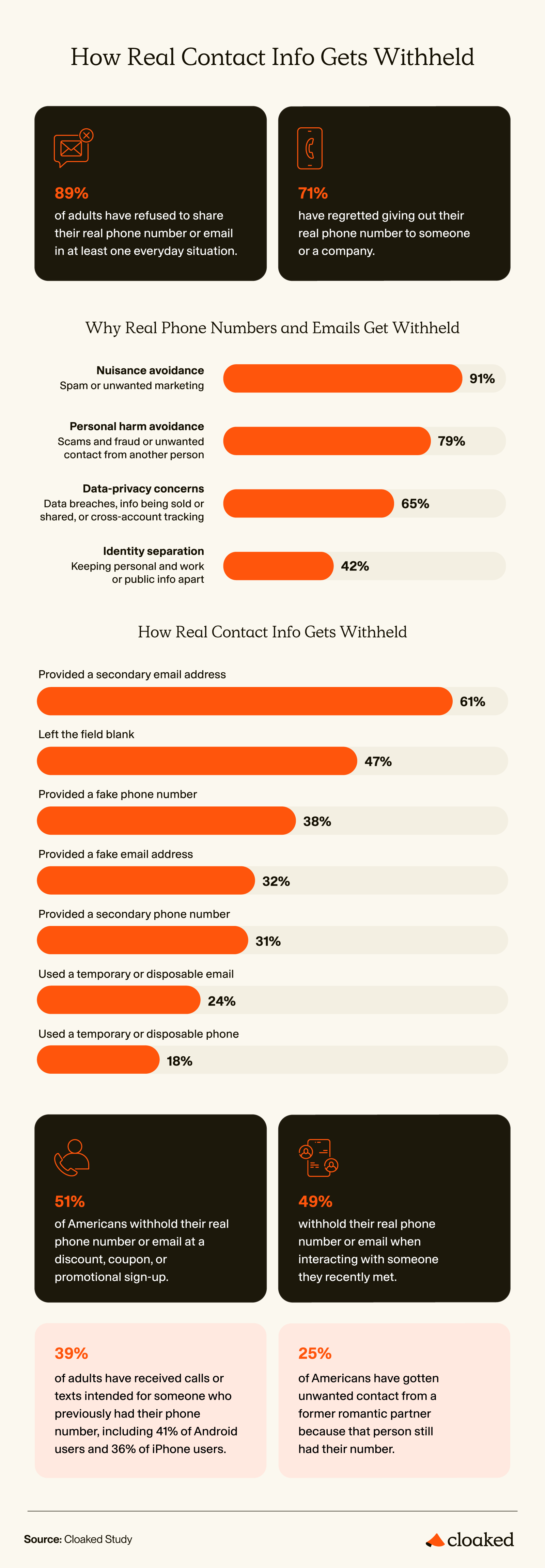
- Nearly nine-tenths of Americans (89%) refuse to share their real phone number or email in at least one everyday situation.
- Gen Z is three times more likely than baby boomers to withhold contact info on a job application (22% versus 7%).
- 90% of both Gen Z and millennials refuse to share their contact info in some everyday situation, compared with 81% of baby boomers.
- Nearly all Americans (97%) cite at least one reason for withholding contact info, led by avoiding nuisance contact (91%), personal harm like scams or fraud (79%), and data-privacy concerns (65%).
- 92% of adults use a workaround, most often a secondary email address (61%), a blank contact field (47%), or a fake phone number (38%).
- More than seven in 10 Americans (71%) regret giving out their real phone number, most often to a company or business. Women report regret more than men (76% versus 66%).
- Android users are more likely than iPhone users to say they avoid sharing their real contact info because of data-privacy concerns (68% versus 61%), and are also more likely to have received wrong-number calls or texts (41% versus 36%).
- 39% of Americans receive calls or texts meant for a previous owner of their number, and another 39% get unwanted contact from someone in their past who still has their old number.
Methodology
We surveyed 1,006 Americans about how long they have used the same primary phone number and email address to understand how those long-held contact details shape spam exposure, breach risk, and everyday privacy decisions. The survey examined how many accounts respondents have tied to a single phone number or email, how often they receive unwanted contact such as spam texts, robocalls, marketing messages, and scam attempts, whether their contact details have appeared in known data breaches, and the situations, tactics, and reasons behind avoiding sharing real contact information.
The average age of respondents was 42. The gender breakdown was 51% women, 49% men, and less than 1% nonbinary or not listed. Millennials made up the largest share of respondents (45%), followed by Gen X (26%), Gen Z (19%), and baby boomers (10%). Most respondents use an iPhone as their primary smartphone (50%), while 49% use an Android device and less than 1% use another type of smartphone or do not use a smartphone at all. Percentages may not sum to 100% due to rounding.
The survey was conducted online in August 2026.
About Cloaked
Cloaked helps people stop handing the same phone number and email to everyone who asks for one, rather than exposing a single contact detail to spam and breach risk for over a decade. With Cloaked, each account, app, or sign-up gets its own masked number or email alias, any of which can be shut off the moment unwanted contact starts.
Fair Use Statement
This survey and its findings are free to reference for noncommercial coverage, so long as Cloaked is credited with a link to this page. Reach out to Cloaked directly for any commercial licensing or press requests.




