Ask most Americans what worries them about their privacy, and they will name a stolen password or a hacked account. Almost nobody names the thing that makes those attacks work in the first place: a market where your name, address, and phone number get bought and sold, legally, every day.
We surveyed 1,011 Americans about what they know, what they fear, and what they feel powerless to stop. The gap among these is wider than you would expect, and it shapes everything from how safe people feel to whether they believe they can do anything about it.
Key Takeaways
- More than 2 in 3 Americans say it feels more violating for a company to legally buy their personal data than for a hacker to steal their password.
- Nearly 3 in 4 Americans (73%) cannot explain what a data broker is.
- Over 3 in 5 Americans (63%) believe their personal information is already being bought and sold.
- Nearly 9 in 10 Americans (86%) believe their personal information gets less private every year.
- More than 1 in 5 Americans (22%) have never once searched their own name to see what is public.
- More than 9 in 10 Americans (92%) would support making it illegal to sell personal data without consent.
The Threat Hiding in Plain Sight
Most Americans have already been touched by the data economy, even if they cannot name it.
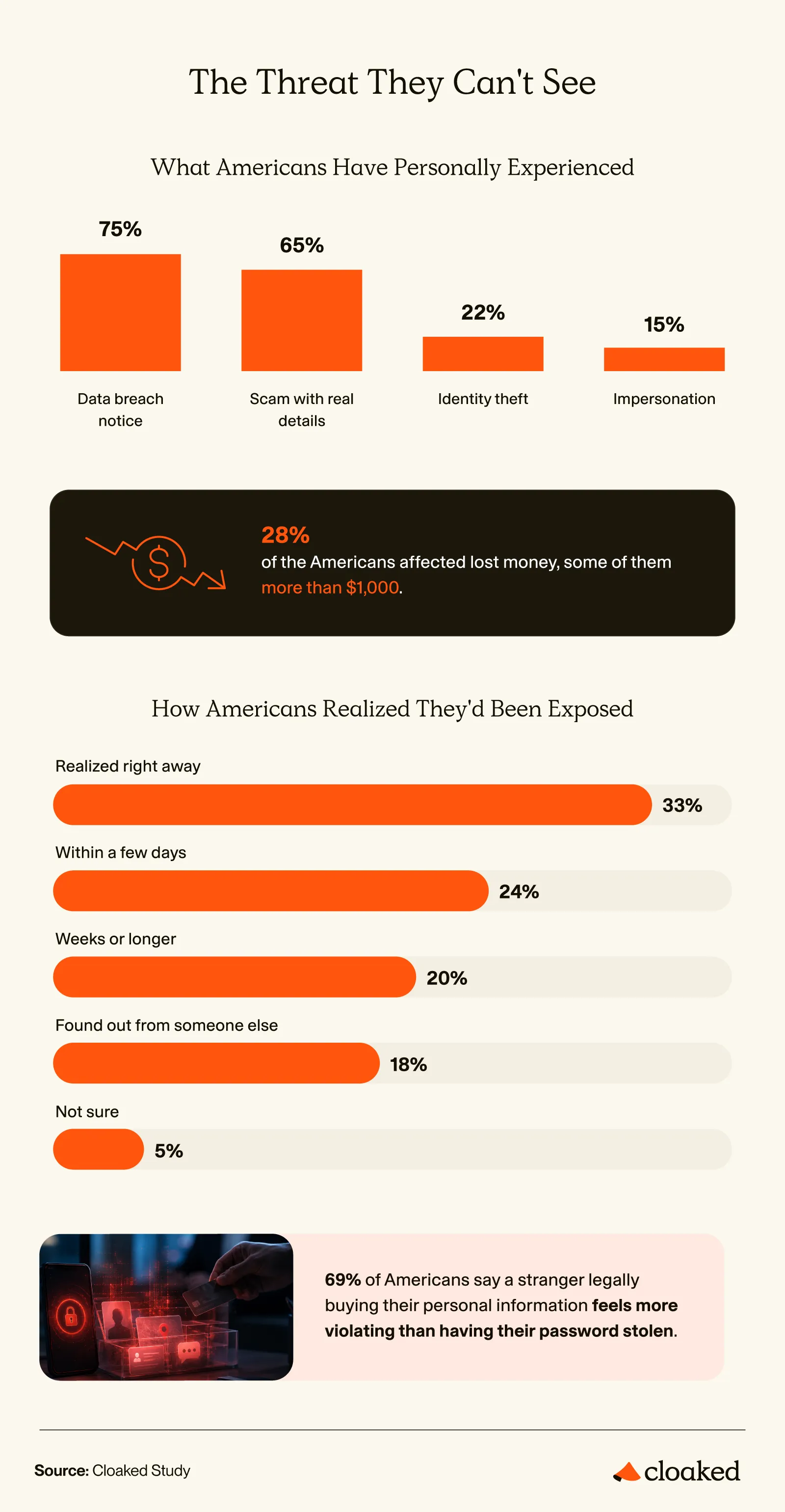
Almost everyone has been through some version of this. More than 9 in 10 Americans (94%) had faced at least one scam, breach, impersonation, or identity theft, and 59% had faced two or more. Data breach notices were the most common experience, reported by 75% overall and by 81% of Gen X. Among the people affected, 28% lost money, some of them more than $1,000.
What most people could not see was how the damage happened or how long it took to notice. Only a third of those affected (33%) realized right away that their information had been compromised, while nearly one-fifth (18%) only found out because someone else told them. Older Americans were the most likely to hear it from someone else, with 25% of baby boomers and 24% of Gen X finding out that way.
The awareness gap runs deep. Nearly three-quarters of Americans (73%) could not explain what a data broker is, even though more than three in five (63%) believed their personal information was already being bought and sold, and more than half (58%) did not know it is legal for a company to buy and sell it. The disconnect shows in what people fear most: more than two-thirds of Americans (69%) said a stranger legally buying their personal information would feel more violating than having their password stolen.
The Illusion of Control
Feeling in control of your information and actually being able to control it turned out to be very different things.
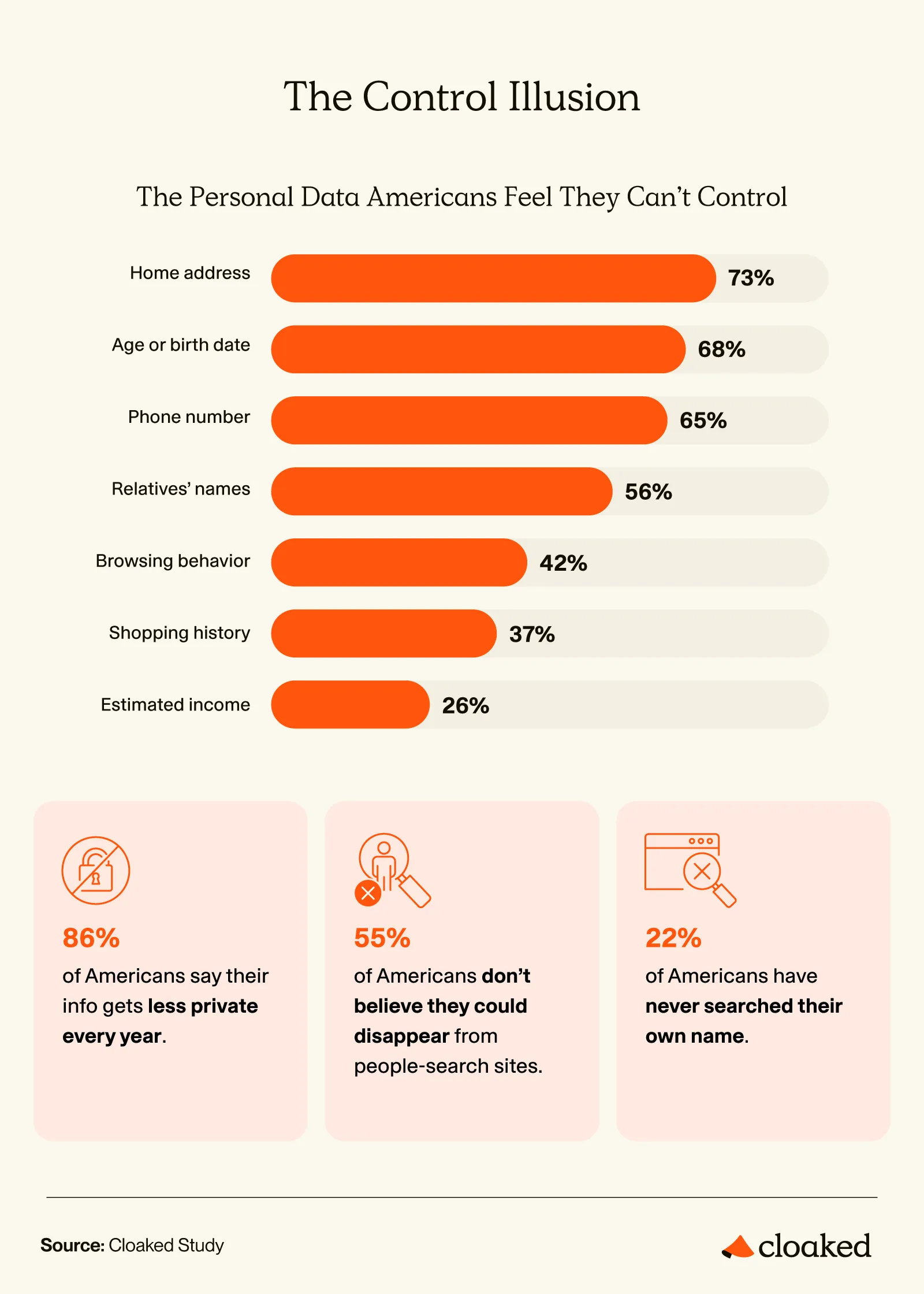
Eighty-six percent of Americans believed their personal information gets less private every year, a view strongest among Gen X and baby boomers (89% each). Yet more than one-fifth (22%) had never once searched their own name to see what is public, a share that climbed to 32% among baby boomers.
The people who had looked often did not like what they found. Among those who had searched themselves, just over half (51%) were surprised by how much was public. When asked what they felt they could not control, baby boomers led the way, with 82% saying they had no say over who can access their home address. Only about one in seven Americans (14%) believed they could remove themselves from people-search sites if they tried, and another 30% were not sure they could.
Resigned or Ready to Fight Back?
Learning how exposed they are pushed Americans in one of two directions.
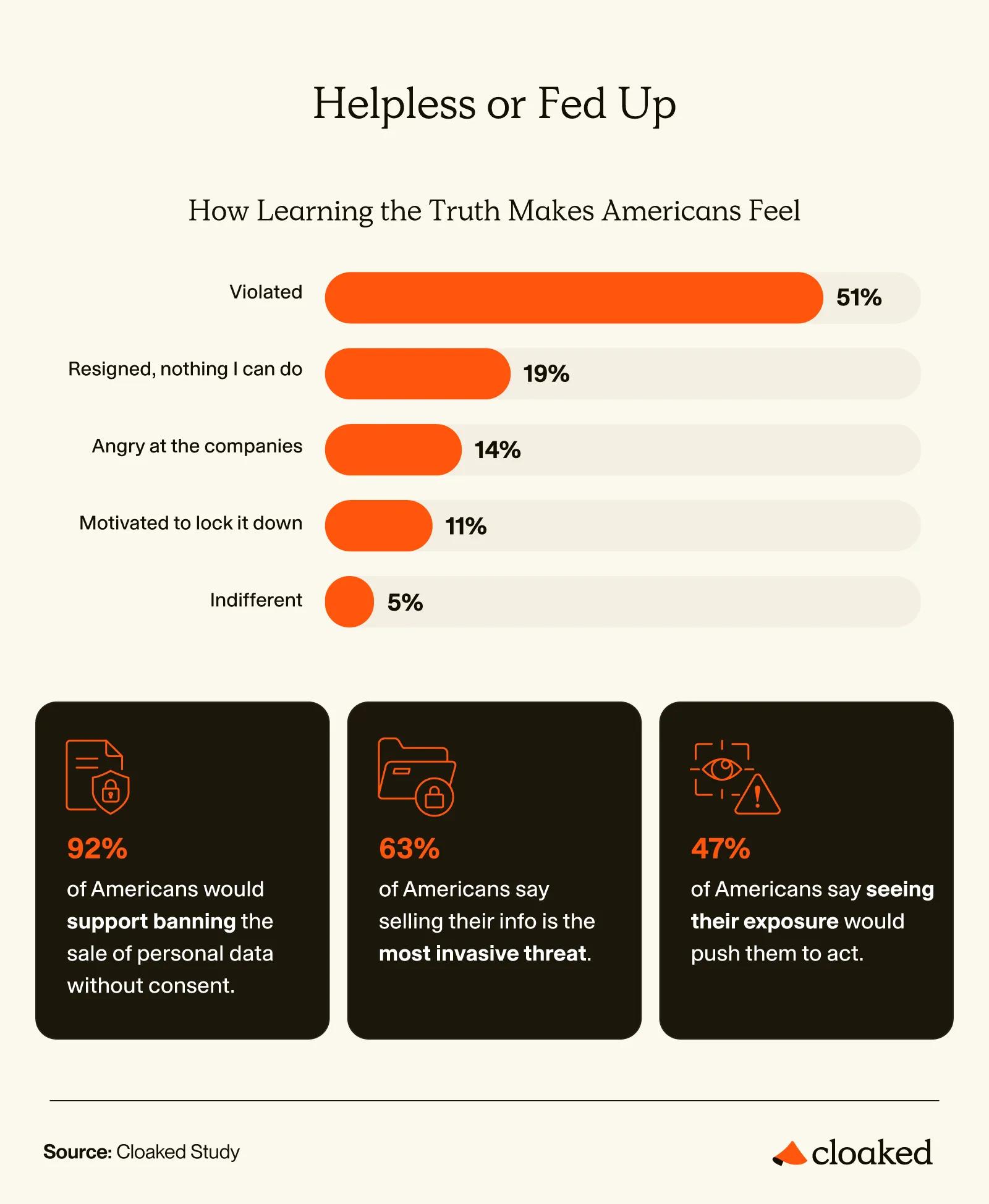
For some it was resignation. For many more it was resolve. Gen Z were the most likely to say that seeing their own exposure firsthand would push them to act (51%), followed by millennials (48%), Gen X (45%), and baby boomers (34%).
There was also broad agreement about where the problem sits. Millennials were the most likely to call companies selling their information the most invasive threat (67%), and just 6% of Americans named AI knowing their habits as the most invasive threat, compared with the 63% who pointed to companies selling their data. That consensus carried into policy, as 92% of Americans would support making it illegal to sell personal data without consent, a figure that held steady even among people who had already been scammed or had their identity stolen (also 92%).
What the Exposure Gap Reveals
The thread running through all of this is not apathy. Most Americans can feel that their information is exposed. What they cannot see is the machinery behind it, or the levers that might shut it off. The encouraging part is how ready people are to change that once the picture gets concrete. Give them a clear look at their own exposure and a realistic way to act, and resignation starts to look a lot more like resolve.
Methodology
A survey of 1,011 U.S. adults was conducted on behalf of Cloaked in July, 2026, to measure the gap between how exposed Americans believe they are online and how exposed they actually may be. Respondents were asked about the scams, breaches, and identity theft they have personally experienced, their awareness of data brokers, and whether their information is being bought and sold, how much control they feel over their personal details, and how they respond to learning how exposed they are.
The generational breakdown was Gen Z (19%), millennials (45%), Gen X (27%), and baby boomers (9%). By gender, respondents were men (49%), women (50%), and non-binary or preferring not to say (1%). Percentages may not total 100% due to rounding.
About Cloaked
At Cloaked, we help people take back control of their personal data and reduce the spam that comes with overexposure. Call Guard screens unknown callers in real time, Data Removal helps remove exposed personal information from 120+ data brokers, and Cloaked Identities lets you create unique email aliases and phone numbers so you don't have to share your real contact details everywhere. These tools help make everyday communication feel more private, secure, and trustworthy.
Fair Use Statement
This content may be shared for noncommercial purposes only. If reused, please include proper attribution and a link back to Cloaked.