



Long before a child can create a password or understand what the internet even is, their name, face, and birthday are often already online. A pregnancy announcement, a first day of school photo, or a school app that logs a home address each adds to a digital footprint the child never agreed to build. Federal rules like the Children's Online Privacy Protection Act (COPPA) limit how companies collect data from kids under 13, but not what parents themselves choose to post.
Cloaked surveyed 1,011 U.S. parents about when they first posted about their child, what personal details they've shared, and how AI concerns are changing what they're willing to put online, along with the ages kids reach milestones like their first smartphone and first unsupervised hour online. Below is what the data shows about how much of a child's life ends up online, and how old kids are before anyone asks their opinion about it.
Key Takeaways
- 46% of children have an online presence before they are even born, first appearing in a pregnancy announcement or sonogram post by a parent.
- By age 4, the average child has already had their name, birthday, photo, milestones, and school all shared online by a parent (face photo, name, birthday, and milestones typically go online by age 1; school by age 4).
- The average child gets their first smartphone at age 10, their first social media account at age 12, and unsupervised internet access at age 10.
- 28% of parents say they've never asked their child's permission to post about them on social media.
- Facebook is the most common place parents post about their kids, named by 85% of parents, ahead of Instagram (51%).
- Parents don't start asking their child's permission to post about them until age 8 on average.
- 74% of parents have already changed what they post about their child because of AI concerns, from making accounts private to hiding their kid's face.
Most Children Have a First Name, a Face Photo, and a Birthday on the Internet Before They Turn 2
Most kids build an online identity long before they can talk, let alone weigh in on it. Parents tend to make that first move earlier than people might expect.

Nearly half of children (46%) already had an online presence before they were born, first showing up in a parent's pregnancy announcement or sonogram post, and that climbed to 74% by their first birthday. By age one, the average child already had a face photo, first name, birthday, and milestones posted online; school didn't typically enter the picture until age four. More identifying details, like a child's current location, come up far less often (8%), suggesting most parents draw an informal line around what feels safe to share.
Facebook was where most of this happened: 85% of parents who posted about their kids do it there, well ahead of Instagram (51%). Gen Z parents leaned more toward Instagram (60%) and TikTok (24%) than Gen X parents (38% and 5%), a sign that where kids' data lives online keeps shifting by generation.
Permission rarely factored into that first post. More than a quarter of parents (28%) said they've never asked their child if it's okay to post about them, and those who did ask didn't typically start until age 8. That gap didn't go unnoticed forever: 64% of parents said someone else had posted about their child without asking, and 37% responded with some kind of relationship action, mothers more often than fathers (40% versus 30%).
By Middle School, the Average Child Has a Smartphone, a Social Media Account, and Unsupervised Internet Access
By the time most kids reach middle school, they're generating their own data trail across apps, games, and school platforms, often without anyone reading the fine print.

The average child got their first smartphone and first unsupervised internet access at age 10, then opened their first social media account at 12. Nearly three-fifths of parents (59%) said their child used at least one app, game, website, or school platform that collects personal information, and more than a third (36%) said three or more.
Oversight was inconsistent. More than one-tenth of parents (14%) didn't know how many data-collecting services their child used at all, which rose to 19% among parents of high schoolers versus 4% of parents of kids ages 0 to 5. Reading the fine print wasn't common practice either: nearly half of parents (49%) whose child used data-collecting apps rarely or never read the privacy policies behind them, and Gen X parents were the most likely to skip them entirely (18%), compared with millennials (15%) and Gen Z (8%).
Nearly half of parents (45%) didn't feel in control of who these services share their child's personal information with, a share that rose to 50% among parents of high schoolers, the group who used the most data-collecting platforms.
Nearly Three-Quarters of Parents Have Already Changed What They Post About Their Child Because of AI Concerns
AI has added a new layer of worry to an old habit. Many parents said it's already changing what they're willing to post.
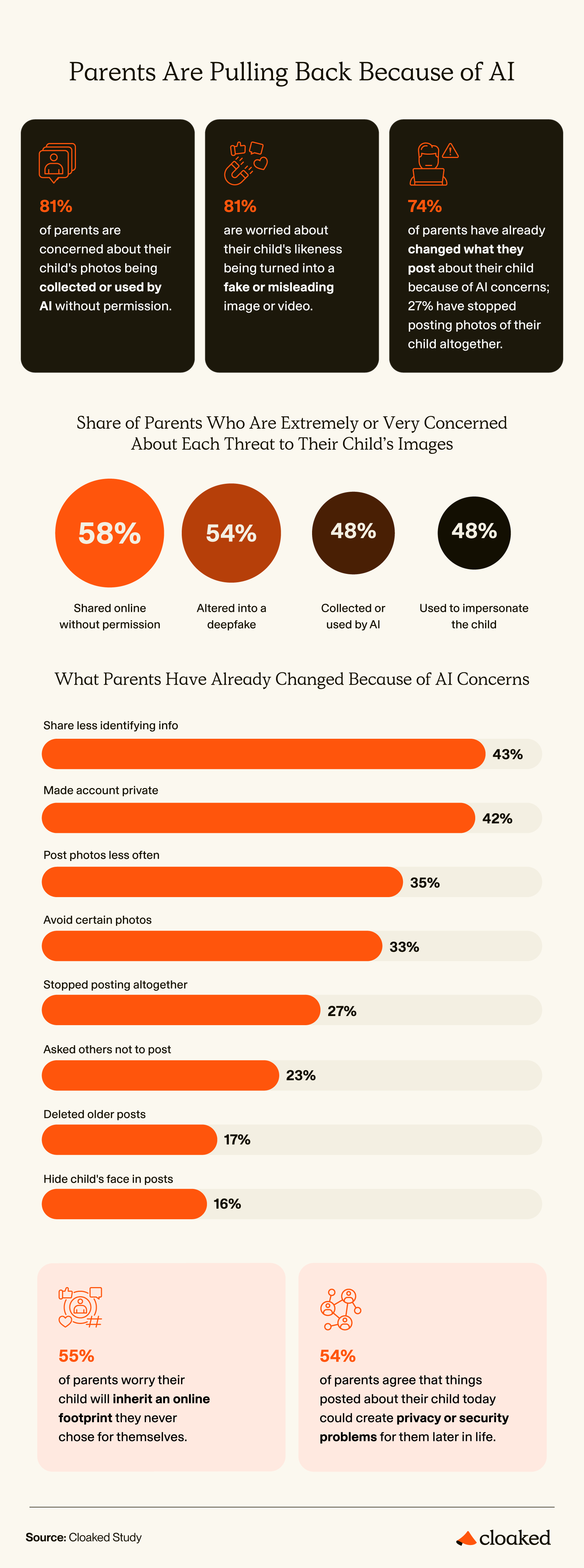
More than half of parents were extremely or very concerned about their child's images being shared without permission (58%), altered into a deepfake (54%), collected or used to train AI (48%), or used to impersonate their child (48%). Those worries weren't abstract: 55% worried their child would inherit an online footprint they never chose, and 54% agreed that what's posted today could create privacy or security problems later in life.
That concern was already changing behavior. Nearly three-quarters of parents (74%) adjusted what they post because of AI, and 27% stopped posting photos of their child altogether. The most common changes among the rest were sharing less identifying information (43%), making accounts private (42%), and posting less often (35%).
Gen Z parents (84%) changed what they post because of AI far more often than Gen X parents (67%), and mothers adjusted their habits more than fathers (79% versus 65%).
Most of a Child's Digital Footprint Is Built Before They Can Weigh In
For most kids, the digital record starts long before they're old enough to read it, let alone approve of it. Parents don't have to stop sharing to change that; treating each post as a small, permanent decision instead of a reflex can help keep a child's footprint smaller and more intentional. Asking a child's opinion earlier than age 8, thinking twice before naming a school or sharing a location, and revisiting privacy settings on the apps and platforms kids use are simple places to start. As AI makes old photos and personal details easier to repurpose, the choices parents make today may matter even more by the time their kids are old enough to make their own.
Methodology
We surveyed 1,011 parents in the United States who have at least one child under age 18 to understand how a child's digital footprint takes shape before the child can consent. The survey examined when parents first share their child online, what personal details they've made public, which platforms they post on, when kids reach major digital milestones like a first smartphone or social media account, how much control parents feel over the data collected about their children, and how AI concerns are reshaping what they post.
The average age of respondents was 39. The parent gender breakdown was 67% women, 32% men, and 1% nonbinary. Millennials made up the largest share of respondents (69%), followed by Gen X (20%), Gen Z (10%), and baby boomers (1%). Respondents answered about one child under 18; that child's age skewed evenly across life stages, with 32% ages 0 to 5, 30% ages 6 to 10, 17% ages 11 to 13, and 22% ages 14 to 17. The child gender breakdown was 53% girls, 45% boys, and 2% nonbinary or preferred not to answer.
The survey was conducted online in August 2026.
About Cloaked
At Cloaked, we empower people to own their data, enabling smarter AI and apps without compromising privacy and safety. For families weighing what to share about their kids online, Cloaked helps remove exposed personal information and limit how much new data gets collected in the first place.
Fair Use Statement
The findings in this report may be shared for noncommercial purposes with proper attribution to Cloaked and a link back to this page. For commercial use or media inquiries, please contact Cloaked directly.




